

Sleep Consistency: What Matters When Life Gets in the Way?
 By Dr. Tom Allen8 min read
On this page
On this page
- Executive summary
- Why sleep regularity matters
- What does the research tell us?
- Sleep, HRV and physiological recovery
- The cumulative effects of insufficient sleep
- When the data doesn't understand the individual
- Building a realistic approach to sleep
- Sustaining performance over time
- What this means in practice
- References and further reading
Photograph: Nicole Bomar / Unsplash. Illustrative photograph.
Executive summary
Sleep is fundamental to health, recovery and cognitive performance. Although most advice focuses on duration, research suggests that maintaining reasonably consistent sleep and wake times is also associated with favourable health outcomes. Much of this evidence remains observational, making individual interpretation important.
Sleep also interacts with physiological responses, including heart rate variability (HRV) and resting heart rate. Wearable technology can help identify meaningful patterns, but the measurements and scores provided do not always reflect someone's circumstances or how they feel.
For people managing demanding professional and personal lives, the priority should be understanding their normal sleep patterns, recognising when circumstances change and identifying realistic opportunities to support recovery.
Sleep is one of the most discussed aspects of health and performance. With the increasing availability of wearable technology, people now have access to detailed information about how long they sleep, the timing of their sleep and their estimated recovery.
Yet much of our attention remains focused on individual nights and the scores we receive the following morning. While these measurements can be valuable, they provide only part of the information needed to understand someone's health and performance.
During my career in professional football, sleep was one of several factors we considered when understanding how players responded to training, competition and travel. Late fixtures, early departures and personal commitments meant that sleep opportunities were rarely identical from one day to the next.
Understanding whether someone had experienced one disrupted night or accumulated several nights of insufficient sleep was important. The measurement might look similar, but the implications could be different.
The same applies to people working in demanding professional environments. Sleep needs to be considered across longer periods and alongside the circumstances influencing it.
Why sleep regularity matters
Most established guidance focuses on duration. The American Academy of Sleep Medicine and Sleep Research Society recommend that adults regularly obtain at least seven hours of sleep, while recognising that individual requirements vary.
Sleep timing is also important. Our bodies operate through circadian rhythms that influence alertness, hormone release and other physiological processes. These rhythms interact with environmental signals, particularly light, and our daily routines.
In 2023, a National Sleep Foundation expert panel reviewed 63 publications examining sleep regularity and concluded that consistent sleep and wake times were important for health and performance.
The panel also acknowledged that obtaining additional sleep after periods of insufficient sleep can be beneficial. This distinction matters because rigidly maintaining the same waking time should not come at the expense of repeatedly obtaining inadequate sleep.
The aim should be to achieve sufficient sleep while maintaining a reasonably consistent pattern wherever circumstances allow.
What does the research tell us?
A large prospective study published in Sleep in 2024 examined sleep regularity in 60,977 UK Biobank participants. Researchers used wearable accelerometer data to assess sleep patterns before following participants for mortality outcomes over an average period of 6.3 years.
Greater sleep regularity was associated with lower mortality risk, and within the statistical models used, regularity was a stronger predictor than average sleep duration.
However, this was observational research. It cannot establish that changing someone's sleep schedule would directly reduce their mortality risk. The participants were also generally older adults, which should be considered when applying findings to younger professional populations.
Similarly, research involving 1,992 participants in the Multi-Ethnic Study of Atherosclerosis found that greater variability in sleep duration and timing was associated with a higher risk of cardiovascular events.
Together, these findings suggest that sleep regularity deserves consideration alongside duration and quality. They do not provide a universal target that every individual should follow.
Sleep, HRV and physiological recovery
Sleep also influences physiological measures increasingly available through wearable technology.
Heart rate variability (HRV) measures variation in the intervals between successive heartbeats and provides information about aspects of cardiac autonomic regulation. A 2025 systematic review and meta-analysis involving 11 studies and 549 participants found that sleep deprivation was associated with reductions in RMSSD, a commonly used HRV measure, although changes across other HRV measures were less consistent.
Resting heart rate and HRV may change alongside periods of inadequate sleep, but these measures are also influenced by exercise, psychological stress, illness, medication and other factors. The device, measurement method and timing also affect interpretation.
Importantly, HRV is not a direct measure of recovery or a definitive indicator of readiness to perform. A lower reading does not automatically mean someone is insufficiently recovered, just as a higher reading does not guarantee they are ready for greater demands.
The value comes from understanding someone's usual physiological patterns and considering changes alongside their sleep history, subjective experience and current circumstances.
The cumulative effects of insufficient sleep
One disrupted night and repeated sleep restriction can have different implications.
In a controlled study published in 2003, Van Dongen and colleagues investigated the effects of restricting sleep opportunity to four, six or eight hours per night over 14 consecutive days.
Participants in the restricted sleep conditions demonstrated cumulative deterioration in measures of cognitive performance, particularly sustained attention. Their subjective reports of sleepiness did not always reflect the extent of the objective impairment.
This highlights why personal perception remains important but should be considered alongside other information. Someone may become accustomed to feeling tired without recognising how sustained sleep restriction is affecting aspects of their performance.
For executives managing extended periods of pressure, understanding the pattern developing across several days or weeks may therefore be more useful than responding to an isolated poor night.
When the data doesn't understand the individual
One concern I have with the increasing use of wearable technology is how readily people allow a provider-generated score to determine their perception of sleep.
Someone may wake feeling reasonably refreshed, look at their wearable and discover that their sleep has been rated poorly. That number may influence how they interpret the night, despite their initial experience suggesting otherwise. The reverse can also happen, with a favourable score encouraging someone to overlook tiredness or reduced alertness.
I would encourage people to consider how they feel before looking at their data. Did they feel they slept well? Do they feel rested? How is their energy and alertness this morning?
These observations provide valuable information. They are not always reliable indicators of objective performance, particularly during sustained sleep restriction, but neither should they be disregarded because an algorithm produces a different assessment.
A further limitation is the difficulty technology has in understanding the circumstances surrounding a measurement.
Consider someone who has recently welcomed a newborn baby. Their sleep may become substantially shorter and more fragmented, with limited control over when interruptions occur. Their wearable might repeatedly produce poor sleep scores, even though they already understand why their sleep has deteriorated.
During this period, obtaining four hours of sleep might represent a meaningful improvement compared with the preceding nights. Four hours remains insufficient for most adults, particularly if sustained, but it could still be a positive change relative to that person's immediate circumstances.
A device may continue to classify the night as poor because it is comparing the measurement with established thresholds or previous patterns. That assessment offers limited insight into the individual's situation or what they can realistically change.
For a new parent, recommendations to maintain an identical bedtime or eliminate overnight interruptions may be impractical. More useful support might involve protecting available sleep opportunities, sharing responsibilities where possible and adjusting other demands during a period of restricted recovery.
The same principle applies to international travel, illness, unusually demanding working periods and other significant life changes.
Wearable technology can identify changes in sleep, HRV and resting heart rate, but these measurements do not necessarily explain why the changes have occurred or what response is appropriate.
For me, the greatest value of these technologies lies in identifying patterns that lead to better questions. A sustained change in sleep or physiological measures may justify exploring what has changed in someone's circumstances and whether there is a meaningful opportunity to intervene.
The information becomes more useful when combined with the individual's experience, recent history and understanding of their own life.
Building a realistic approach to sleep
For someone managing substantial professional and personal demands, I would begin by understanding their usual sleep routine and the circumstances that most frequently disrupt it.
This includes considering typical sleep and wake times, how those patterns change between working and non-working days, and how the individual feels and functions across those periods.
From there, the priority is identifying the most relevant and achievable improvement.
For one person, that might involve maintaining more consistent sleep times during ordinary working weeks. Another may benefit from protecting additional sleep opportunity, reducing avoidable late-evening commitments or planning more carefully around travel.
Light exposure, physical activity, caffeine, alcohol and other daily habits can also influence sleep, although their relative importance will vary between individuals.
Where persistent sleep difficulties or excessive daytime sleepiness are present, appropriate clinical assessment may be necessary.
The objective is to create a sustainable approach that supports health and recovery within the realities of the individual's life.
Sustaining performance over time
The demands of professional sport reinforced the importance of understanding performance across longer periods. Training, competition, recovery and the circumstances outside sport all interact, meaning decisions need to consider both immediate demands and their cumulative effects.
The same principle applies to executive performance. Sleep duration, regularity, physiological responses and subjective experience each provide useful information, but their significance depends on the person and the circumstances in which they occur.
Research supports the importance of sufficient and reasonably consistent sleep, while also showing how repeated restriction can affect cognitive performance. Wearable technology can contribute to understanding these patterns, provided its measurements are interpreted appropriately.
For people managing demanding lives, the greatest opportunity often comes from recognising where disruption is unavoidable, where routines can realistically improve and when additional recovery needs to be prioritised.
Across a long period, consistency matters. Achieving it requires an approach that is informed by evidence, individual context and an understanding of what is realistic.
What Professional Sport Can Teach Executives About Sustaining Performance
What this means in practice
- Your normal pattern: Are you regularly obtaining sufficient sleep, and how consistent are your sleep and wake times?
- Your circumstances: What is influencing your sleep, and which demands are within your control?
- Your own experience: How do you feel before looking at your wearable information?
- Your physiological responses: Are changes in HRV, resting heart rate or other measures consistent with your recent sleep, activity and wider circumstances?
- Your next priority: What realistic adjustment would provide the greatest benefit within your current situation?
References and further reading
- Sletten, T. L., et al. (2023). The importance of sleep regularity: a consensus statement of the National Sleep Foundation sleep timing and variability panel. Sleep Health, 9(6), 801–820. https://doi.org/10.1016/j.sleh.2023.07.016
- Windred, D. P., et al. (2024). Sleep regularity is a stronger predictor of mortality risk than sleep duration: A prospective cohort study. Sleep, 47(1), zsad253. https://doi.org/10.1093/sleep/zsad253
- Huang, T., Mariani, S., & Redline, S. (2020). Sleep irregularity and risk of cardiovascular events: The Multi-Ethnic Study of Atherosclerosis. Journal of the American College of Cardiology, 75(9), 991–999. https://doi.org/10.1016/j.jacc.2019.12.054
- Van Dongen, H. P. A., Maislin, G., Mullington, J. M., & Dinges, D. F. (2003). The cumulative cost of additional wakefulness: Dose-response effects on neurobehavioral functions and sleep physiology from chronic sleep restriction and total sleep deprivation. Sleep, 26(2), 117–126. https://doi.org/10.1093/sleep/26.2.117
- Zhang, S., Niu, X., Ma, J., Wei, X., Zhang, J., & Du, W. (2025). Effects of sleep deprivation on heart rate variability: a systematic review and meta-analysis. Frontiers in Neurology, 16, 1556784. https://doi.org/10.3389/fneur.2025.1556784
- Watson, N. F., et al. (2015). Recommended amount of sleep for a healthy adult: A joint consensus statement of the American Academy of Sleep Medicine and Sleep Research Society. Sleep, 38(6), 843–844. https://doi.org/10.5665/sleep.4716
About P1 ELEVEN
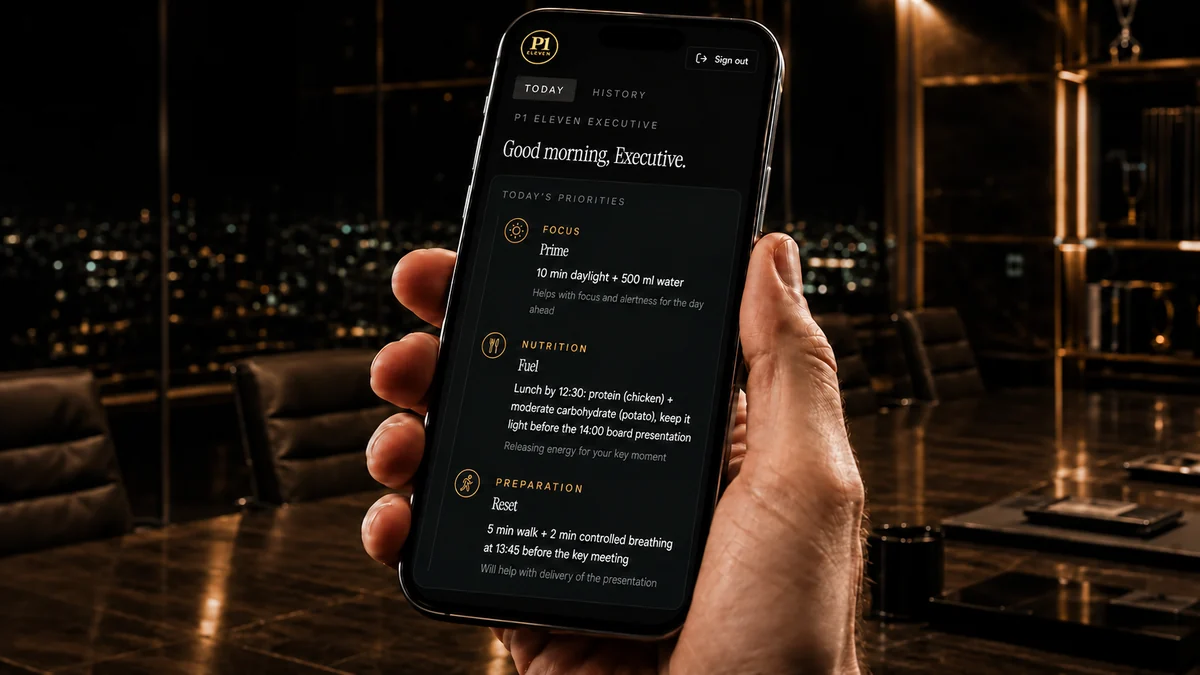
P1 Eleven Executive brings together information about sleep, recovery, daily demands and personal circumstances to help identify practical priorities. Individual context, personal discussion and human judgement inform how that information is interpreted and applied.
Explore P1 Eleven Executive: https://p1eleven.com/executive
P1 Eleven provides performance and lifestyle support. It does not provide medical diagnosis or treatment.
Related Insights
What Is Executive Performance?
Understanding executive performance, how sleep, recovery, workload, exercise and context influence senior leaders, and what professional sport can teach executives.

From the game model to the training week
How shared football intentions connect coaching, physical preparation and the training week, with practice and review shaped around the game model.

From knowledge to practice: developing as a performance practitioner
Why technical knowledge, people skills and context matter when learning from others and developing as a performance practitioner.